Evonne Lawrence recalls one of her most memorable experiences at work in 1998, when Loyola University New Orleans moved from the Main Library to the new J. Edgar and Louise S. Monroe Library. The old building lacked an elevator, so Lawrence and her colleagues loaded books onto carts, wrapped the carts in plastic wrap, and sent them down a chute to staff waiting below.
“That was the most fun I’ve ever had in the library,” Lawrence said.
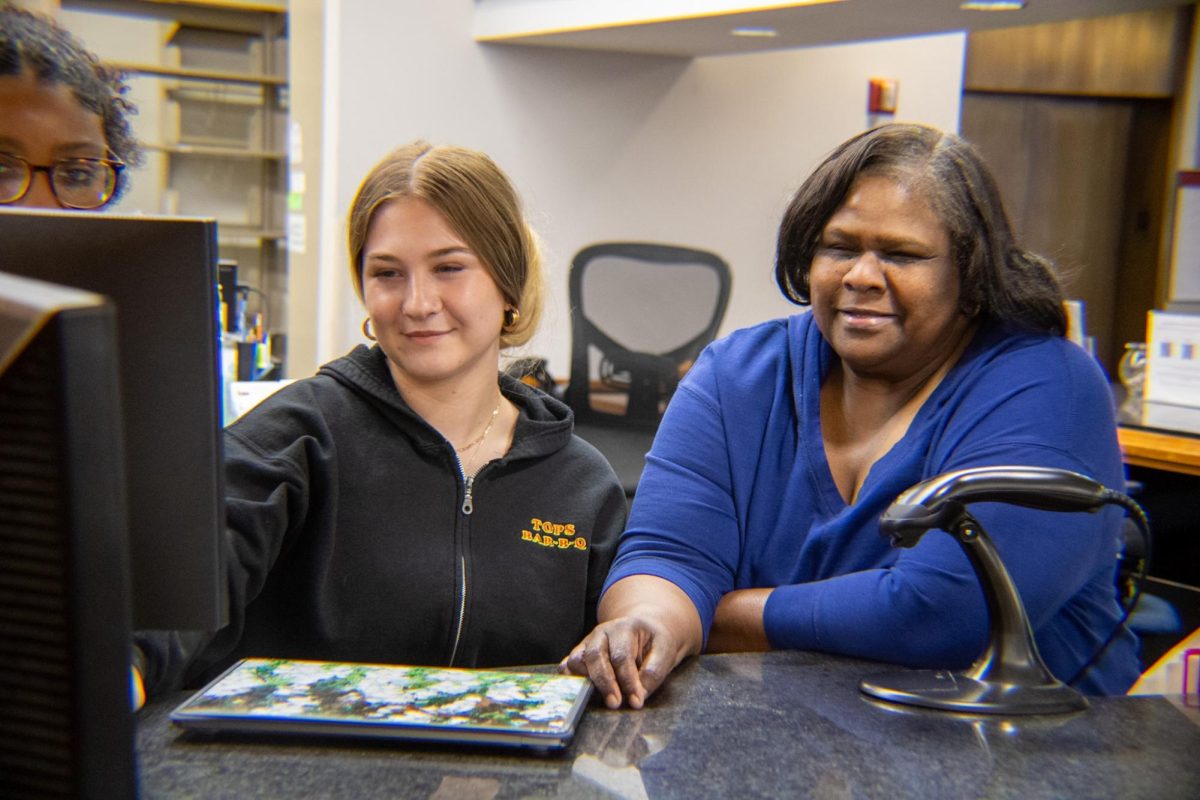
Lawrence is the Learning Commons director at Monroe Library, where she manages circulation functions, supervises staff and student employees, and oversees the day-to-day operations. She began working at Loyola in 1985, starting in the Main Library before the Monroe Library opened to the public on Jan. 11, 1999.
During Lawrence’s tenure, the library has undergone significant changes. When she started, card catalogs and typewriters were common. The transition to digital systems required extensive work behind the scenes.
“The transition wasn’t as hard as you would think,” Lawrence said. “It was more of the back end of it, because what people didn’t realize was what was going on in the back end of it. The people who had to make that happen, that was a nightmare.”
Lawrence viewed the shift to digital technology as a learning opportunity. She adapted to the new systems, while some students and older faculty members found the changes challenging.
“The shift for me was good, but a lot of people didn’t like the change,” Lawrence said. “And still to this day, a lot of older professors are not too happy about technology.”
In March 2020, during the COVID-19 pandemic, Monroe Library shifted to a no-contact operation. Students could no longer browse the stacks freely and instead requested materials by phone or email, with staff retrieving items for pickup at the front desk.
“It was kind of creepy in a way, you know, because when you’ve been around as long as I have, you missed that contact,” Lawrence said. “It was very different. Very different. But it worked. We made it work.”
Lawrence’s responsibilities include supervising Learning Commons staff, managing laptop loan checkouts, coordinating circulation functions and systems, overseeing reserves of textbooks and course materials, and supervising staff who maintain physical collections. She also handles patron data and record keeping, orders supplies, and manages circulation agreements between Monroe Library and other institutions.
Lawrence said the scope of her work is sometimes underestimated.
“I don’t think people realize that I’m dealing with 30 to 35 people daily,” Lawrence said.“My head’s spinning from the time I get here to the time I leave.”
Managing student workers and staff requires continuous attention and guidance. Lawrence likened it to running a daycare, with constant supervision and direction.
“I love it, so it’s okay,” she said.
Taylor Berry, a Learning Commons assistant who has worked at the library since January 2023, described Lawrence as open to listening and collaborative.
“She is a very genuine person,” Berry said. “She is always open to listening to people’s comments and will work with people on their problems or questions.”
Berry said Lawrence balances professionalism with a welcoming approach, regularly considering student input and making changes to improve the library environment.
“She really cares about her students,” Berry said, referring to student employees.
Trina Trinh, a Learning Commons student assistant majoring in entrepreneurship and economics, said Lawrence treats student workers with respect and creates a supportive environment. According to Trinh, Lawrence offered flexibility during a personal issue and praised her problem-solving skills and fairness.
“She knows how to handle problems,” Trinh said. “She is very fair.”
Lawrence said the most meaningful aspect of her career is the relationships she has built with students over the past four decades.
Her office wall displays cards and messages from former student workers who keep in touch years after graduation. Some of those relationships date back 20 years, according to Lawrence. One former student worker became a library colleague, and that co-worker’s daughter graduated from Loyola last year.
“When I think about it, that makes me mother hen now,” Lawrence said.
Lawrence said ongoing connections with students illustrate the role libraries play in building lasting communities.
Looking ahead, Lawrence hopes academic libraries will continue emphasizing student engagement and expanding spaces students use most. Study rooms remain in high demand at Monroe Library, and Lawrence said she would like to create more collaborative spaces.
“We would love to have more study rooms because we know students love them,” she said. “We just can’t figure out how to make that happen.”
Her vision aligns with Monroe Library’s strategic directions which emphasize creating accessible, comfortable, flexible, active spaces, and fostering engagement with students about their needs and concerns. Lawrence said she approaches library work as a service to students.
As academic libraries adapt to changes in technology and learning environments, Lawrence’s four decades of service highlight the importance of personal connections in education, she said.
As Monroe Library continues to evolve to meet new needs, Lawrence’s contributions will be reflected in the students she has mentored and supported throughout her career.