Loyola University New Orleans is expanding opportunities for transfer students through a new partnership with Mississippi Gulf Coast Community College.
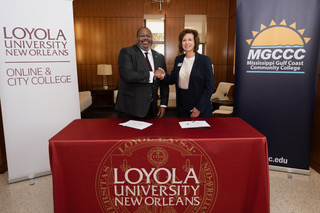
The agreement, formalized April 27, is designed to create clearer academic pathways for students across the Gulf South, particularly those looking to complete bachelor’s degrees after community college. Loyola President Xavier A. Cole and Mississippi Gulf Coast Community College President Mary S. Graham both met on Loyola’s campus to sign a Memorandum of Understanding outlining the partnership.
The deal allows graduates from Mississippi Gulf Coast Community College to transfer directly into Loyola University New Orleans’s online Bachelor of Applied Science program. Students who complete their associate degree will be able to transfer all 60 credits and enter Loyola as first-semester juniors.
University officials said the move is aimed at increasing access for working adults and nontraditional students, especially those who need flexible, online options to complete their degrees.
“As someone who grew up in Biloxi, I have seen firsthand the importance of strong educational pathways across the Gulf South,” Cole said. “At Loyola, we are committed to creating opportunities that meet students where they are and help them move forward with purpose.”
The partnership also focuses on strengthening academic collaboration between the two schools and aligning programs with regional workforce needs, according to the release.
Graham said the agreement will help students transition more smoothly into four-year programs.
“This agreement creates meaningful opportunities for our students to continue their education in a seamless and supportive way,” Graham said.
The partnership is part of Loyola’s broader effort to expand its presence across the Southeast. The university has recently developed similar agreements with institutions including Delgado Community College and Baton Rouge Community College.
University officials said the goal is to create more accessible and efficient pathways for students while addressing workforce demands in the region.