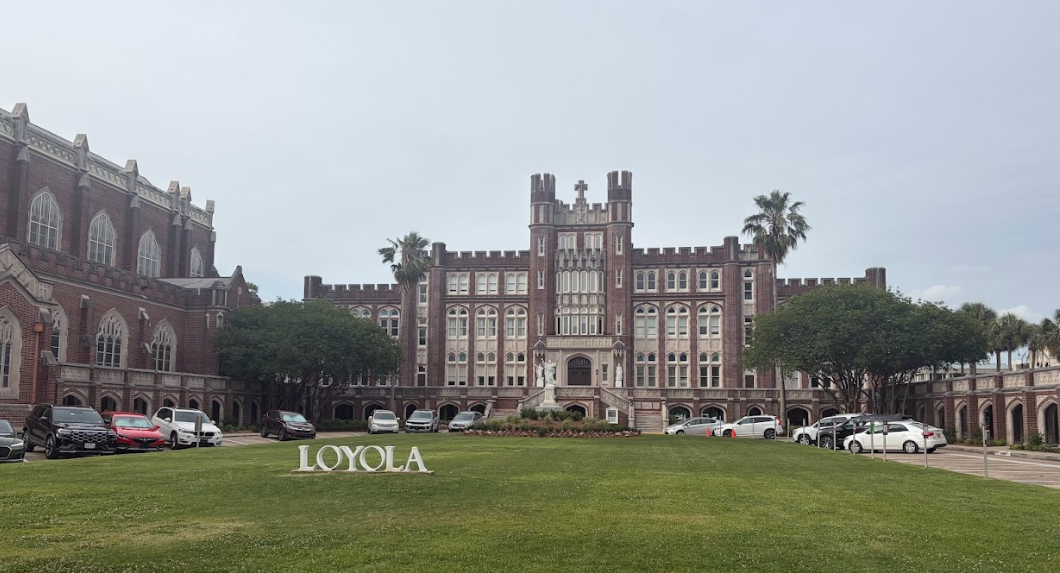
When Loyola alum Warren Zanes reflected on his unconventional collegiate experience at Loyola, he described it as a time of “voracious intake.”
Zanes recently had his book “Springsteen: Deliver me from Nowhere” adapted for the big screen, and he’s seen a lot of commercial success in the rock biography business.
In 1985, a 20 year old Zanes was living on Magazine street, and a girl he was seeing at the time told him he’d be more interesting if he took a couple of classes.
“The closest university was Loyola, and the plan was to take two classes” Zanes explained, noting that he never even enrolled at Loyola, he just asked the admissions office to let him take a couple of courses.
His arrival at the university came at a rough period in his life- Zanes described himself as being “disappointed to the point of being heartbroken” after leaving the rock and roll band he had been touring with.
“I’d had this experience in a rock band, but I did not want anyone to know about it,” he said.
Zanes kept the information about his past with the band quiet – it wasn’t until his 3rd year at Loyola when a classmate came up to him with a cassette of the band’s music and asked “Is that you?”
“One day I quit. I moved to New Orleans, and I didn’t know up from down. I didn’t know who I was. I didn’t know what I was doing. I didn’t trust the world,” he said.
Zanes felt a little out of place, noting that he was a freshman in his early 20s, living in an apartment, as opposed to his classmates who lived in dorms.
“The dorms didn’t want someone fitting my description and they were probably smart,” Zanes laughed, before explaining that the beauty of the classroom is the connections it brings. “I had crushes on young women in my classes and that will bring you into your community more quickly than anything else.”
Before long, Zanes was a part of the Loyola community, and formed a band called “Lady Costume” which featured Tracy Santa, a Loyola English faculty member. Zanes and the band played at parties, making rent for his $150/a month apartment on a “sketchy” part of Tchoupitoulas.
Zanes’ loneliness faded away further as he got closer with his professors. One professor in particular that had a lasting impact on Zanes was John Biguenet, a professor who taught Zanes several times. Biguenet ignited Zanes’ passion for reading and writing.
“His strong, informed guidance. taught me a lot about writing that would dictate what my path would be later in my career,” Zanes said.
“I remember giving him a Christmas present one year, and he said, ‘You know, Warren, I’ve only received two presents from students in the entirety of my teaching career. And I think they were both from you,” Zanes said.
Biguenet once gave Zanes a B on an assignment, which dragged down his GPA. Zanes mentioned that he was at the bottom of his class in grade school, yet he turned things around at Loyola. When Zanes pestered Biguenet about the B, the professor’s response was “that’s the grade you deserved.”
They remain friends to this day, and Biguenet jokes that Zanes is still trying to get the grade changed.
Speaking about Zanes, the now-retired Biguenet said “When I got to work in the mornings, Warren would often be waiting outside my office to discuss something he’d read or written. In his final semester, I directed his honors thesis, which was supposed to be forty to fifty pages. Instead, he handed in a short-story collection that ran over 300 pages. It was a great deal of work, both for him and for me. But all these years later, I still remember some of those stories.”
Zanes reminisced on a time his professor and advisor Buddy D’Aquila mentioned the pilgrimage to Santiago de Compostela in a medieval art class, leading to Zanes being given $1,000 to follow the pilgrimage route.
“I went to D’Aquila and said, would you be my faculty advisor if I do this? And he just looked at me like, ‘You’re not gonna do it, though.’ And I said I am.” Zanes said, explaining that he bought a bicycle for $100 and completed the pilgrimage through Santiago and Spain, writing letters to D’Aquila the whole way.
“Here’s this art history teacher who hadn’t seen these cathedrals that he taught me about, and I was out there on my bicycle, seeing them,” Zanes explained.
Ultimately, Zanes came out of Loyola with a double major in art history and creative writing. He didn’t know he fulfilled the requirements of a double major until someone explained it to him:
“Cluelessness was the position I operated from.” Zanes noted.
Other memorable experiences at Loyola for Zanes included a foreign film series screened by Loyola. Most times, it would just be Zanes and the projectionist. He felt that those films were equivalent to a few classes’ worth of education for him.
“If I had been 18, I probably wouldn’t have gone to one of those screenings. But I was this guy who had been in a rock and roll band. And by the time I washed up at Loyola, I was hungry for what the school had to offer,” Zanes said.
Another faculty member that left a mark on Zanes was Father Claude Pavour, who taught one of Zane’s philosophy classes. The rest of Zanes’ classmates were men bound for the seminary.
“They put on a birthday party for me at the seminary that year,” Zanes noted.
The religious element of Loyola wasn’t lost on Zanes.
“By the end, I knew what a Jesuit was, and I believed in that mission. This is a faith-based institution that nonetheless has this very expansive intellectual culture,” Warren explained, noting that Pavour embodied this.
“A lot of my preconceptions were shattered at Loyola, and I’m grateful for that.” Zanes explained.
Growth seems to be a big theme of Zane’s time at Loyola. He noted that he was in his own “little box” when he arrived, but that changed by the time he graduated.
“That’s what can happen in the best case at a university. Some additions are put on that little box, and some windows,” he said.
Today, Zanes works in academia, teaching at New York University in the music and performing arts department. He offers one big piece of advice for students today-to create and consume as much as possible.
“Do the thing. Write. Paint. Nothing can take the place of the doing if you are not putting in the hours. Class isn’t going to be valuable in the way that it might be.” Zanes emphasized.
He describes reading today as an “embattled frontier,” noting that it’s hard to get people reading and writing in the age of smartphones. Building on this, Zanes noted that his job as an educator is to inspire learning.
With a catalog of successful rock biographies and albums behind his belt, Zanes isn’t a stranger to success. Yet when asked about the way he views his success, he explains that his work is never done.
“Maybe because I’m a fearful person by nature, and I think the bottom will drop out.” Zanes said.
He explained that he’s happier in the making of things, rather than promoting them.
“Coming to love writing is the privilege you earn by writing.” He noted about his literary career, before expanding upon his feelings on success. “It’s not that I don’t trust it, but the way I look at it is in terms of what that success might next make possible,” Zanes said.