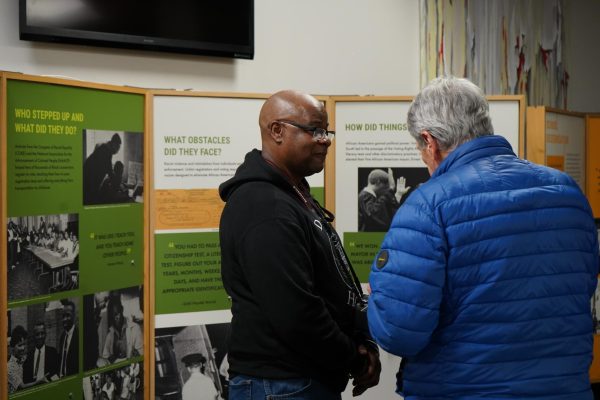
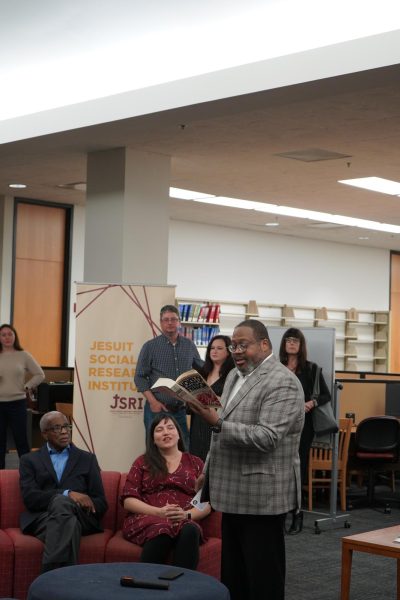
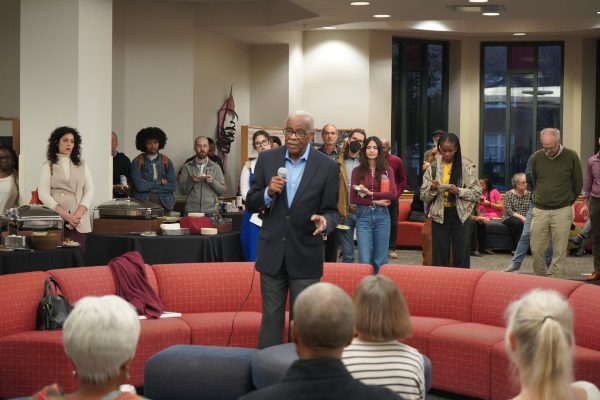
The Jesuit Social Research Institute hosted the opening of “The Trail They Blazed,” an exhibition created by the Historic New Orleans Collection that documents the firsthand accounts of individuals participating in the Civil Rights Movement in Louisiana. These individuals fought for the end of Louisiana’s “Jim Crow Stronghold” era and the birth of an equitable one.
The exhibit opened in Monroe Library on Jan. 22, beginning with Ronnie Moore’s testimony about his experience advocating for equity in Louisiana.
Moore risked his academic career at Southern University by organizing protests to desegregate downtown Baton Rouge lunch counters. Despite his expulsion in 1961, he continued his efforts by serving as field secretary for the Congress of Racial Equality to help organize Freedom Summer from 1963 to 1965. His efforts transformed him into “a true civil rights legend,” according to the JSRI’s newsletter about the exhibit.
After Moore’s speech, participants toured the exhibit together and viewed archived photographs and excerpts illustrating the efforts of other people during the Civil Rights movement in the South.
Alongside The Trail They Blazed exhibit, Monroe Library’s Special Collections & Archives also developed Leading Toward Justice: Loyola, New Orleans, and the Struggle for Civil Rights, a complementary exhibit that highlights the Civil Rights movement on Loyola’s campus, which connects the statewide story of The Trail They Blazed to the university on a deeper level, according to the newspaper.
A few students who have worked in the Special Collections and Archives, including junior Charlotte Byrne and senior Erin Levato, caught wind of the event and decided to attend and view these archives from the Civil Rights movement.
Byrne reflected on one of her favorite archives, which centered around the New Orleans four, four girls that ended up desegregating New Orleans Public Schools.
“It always makes me tear up a little, how brave they were,” she said. “It’s an important testament because, you know, most of them are younger than most of [our] grandmothers… it’s kind of a reminder that it wasn’t that long ago.”
Levato, on the other hand, stated that she got the most out of Moore’s reflection, especially when taking his advice to wake up and keep one’s mind “on mercy and justice.”
Levato also explained her admiration for the consistency of Moore’s work, from him going back to places he visited at 14 years old to reaching out to communities to encourage them to prioritize justice.
“This is the first time I’ve really heard someone who’s very active in civil rights movement speak in person, and just like hearing about how he’s been doing this for 70 years… it’s really impactful,” she said.
Levato also expressed her appreciation that Loyola decided to add this exhibit to the library, especially because of its connections to the students.
“It was so amazing learning about how New Orleans desegregated New Orleans, and it’s the breadth of it here, but also specifically at Loyola, like within our community of students,” she said.
Junior Yeva Guthrie also attended the reception after going to Jolanda Taylor’s other events and hearing about the exhibition from them. Guthrie expressed curiosity about the exhibit due to her dedication to promoting black experiences at Loyola, as seen in her creation of Theatre for the Culture.
“I really love how much change I’ve seen since I’ve been here,” she said. “Seeing how much change has happened with advocacy to see black voices, and to not just glimpse into parts of the history, but do installments like these… I thought that it was just beautiful to be doing something like that.”
Guthrie found so much value in the exhibit because of the individuals participating in it and believes that this involvement makes the experience seem much more realistic.
“It’s not just words. You’re getting the names to the faces, and it makes it seem more personal,” she said. “I think that’s the main issue that we’re having is that a lot of people hear about these names, but they don’t know the people. And it doesn’t connect them to the history if they’re not inclined to learn about it in school.”
These students believe that this exhibit is one that many other students should experience before it closes on April 18 because of its deep connection to the Civil Rights movement, especially regarding Loyola students of that time and other black voices.
“I really hope people actually look at the exhibit, especially students,” Byrne said.