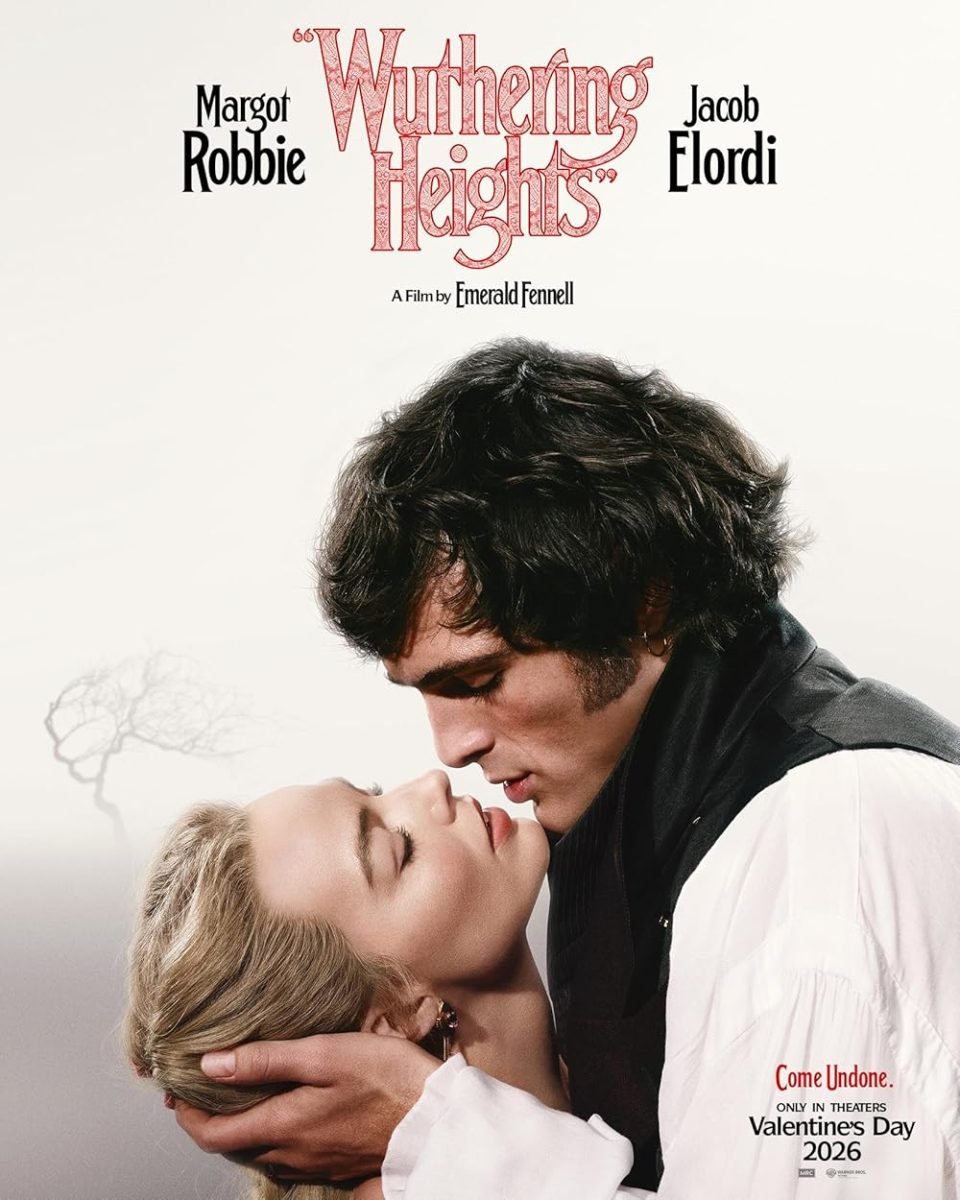
Emerald Fennell needs to put her camera down. The filmmaker known for “Saltburn” and “Promising Young Woman” tried her hand at adapting one of the most nuanced pieces of media, Emily Brontë’s classic novel Wuthering Heights, and failed miserably.
The film focuses too much on aesthetics and lacks substance entirely. It looks good, but there is nothing there. Not to mention the obvious: Margot Robbie cannot play a sixteen-year-old, and Jacob Elordi is a white man from Australia, not a Romani person. And the two don’t even have sexual chemistry.
From the moment I heard about the movie, I knew I wouldn’t like it for reasons I’ll get into, but I still had a glimmer of hope. I thought the “Wuthering Heights” title indicated some sort of meta moment, like a film aware of itself–perhaps it would be a commentary on someone interpreting the novel for the first time? Alas, I was so, so wrong.
I love this book. It is a masterclass in Gothic literature and deserves its classic status in the canon, so as a person forever entranced by Brontë’s prose and as a literature student, I have much to say.
For those who are unaware, Wuthering Heights is a commentary on race, class, and generational trauma. The form of the novel is set up in a haunting, gothic manner–Catherine haunts Heathcliff and her ghostly presence is forever a reminder of his forsaken potential. This is not a love story. This is about two characters, foils of one another, who are so deep into the moral black there is no way to resolve it, so the book’s only hope for resolution is its next generation. (Mind you, Fennell cut the entire second half from the movie. I was so upset that I made my first ever one star review on Letterboxd).
Cathy was a complex, deluded, cowardly brat. Heathcliff was subjected to plethoras of violence and rejection in his childhood, never healed from it, so he perpetuates that violence in adulthood. Fennell’s adaptation barely scratches the surface of any of these themes.
Instead of becoming an inherently horrible human being (beckoning important questions on the ever-present nature vs. nurture problem) Heathcliff is given the “toxic bad boy” trope treatment. He’s toxic so the audience is supposed to love him–they are supposed to forget about his assault and mistreatment of Isabella (his wife), and consider their scenes erotic, consensual. I couldn’t help but wonder if Fennell was trying to turn Heathcliff into a version of Mr. Darcy that’s into BDSM or something.
A huge problem I have is that Heathcliff is not meant to be white in the novel and that is a major reason for his being discriminated against and subjected to structural violence by Catherine’s brother, Hindley.
If someone is going to adapt this story, the bare minimum would involve not casting a white man. Fennell couldn’t even do that. Why? She loves Jacob Elordi too much, so much so that she was willing to let representation fall by the wayside. Once again, Fennell favors aesthetics over substance–the aesthetics in question being Elordi’s abs.
Now, if you know anything about Emerald Fennell, it’s that she has to make literally everything about sex. Don’t call me a prude–I’m not one, I swear, I just think that there is a time and place for eroticism in film. Wuthering Heights is not the time nor the place. Every other scene was trying to be erotic in some way but came off as cringe or disgusting. Fennell was trying to do weird sensual imagery with food, but there was no philosophy behind it, so every attempt fell flat.
In one scene, someone is baking and cracking eggs. The camera focuses on the egg yolk and the gooey whites. In another, Cathy pokes a jello fish at the dinner table. These scenes made literally no sense and didn’t even get a laugh from me. It was like Fennell was trying to reheat her own Saltburn nachos in the ickiest way possible. It wasn’t experimental, nuanced, or avant garde–it was just abject in a laughable way.
More on that, the BDSM and kink stuff was entirely misplaced and made no sense. Two characters that were originally depicted as god-fearing, mumbling comedic relief, were instead showcased a la S&M by Rihanna in a wooden shed. It, again, made no sense. I don’t think the Georgians got down like that.
The scene with Isabella made me the angriest. In the book, Isabella is a literal innocent child subjected to sexual assault by Heathcliff. Fennell fetishizes her in the movie, turning her into some sort of submissive who willingly wears dog collars and barks. It was so distasteful and disheartening to see.
The score by Charli XCX was good, but putting “House” in the first scene elicited many silent giggles from me in the theater. The costumes were misplaced as well. Margot Robbie looks like Holiday Barbie or a Twin Peaks employee wearing milkmaid costumes.
I think it would be in Fennell’s best interest to write a heartfelt apology to the Brontë estate. I bet a trillion bucks that Emily is rolling over in her grave. So are literary scholars everywhere.