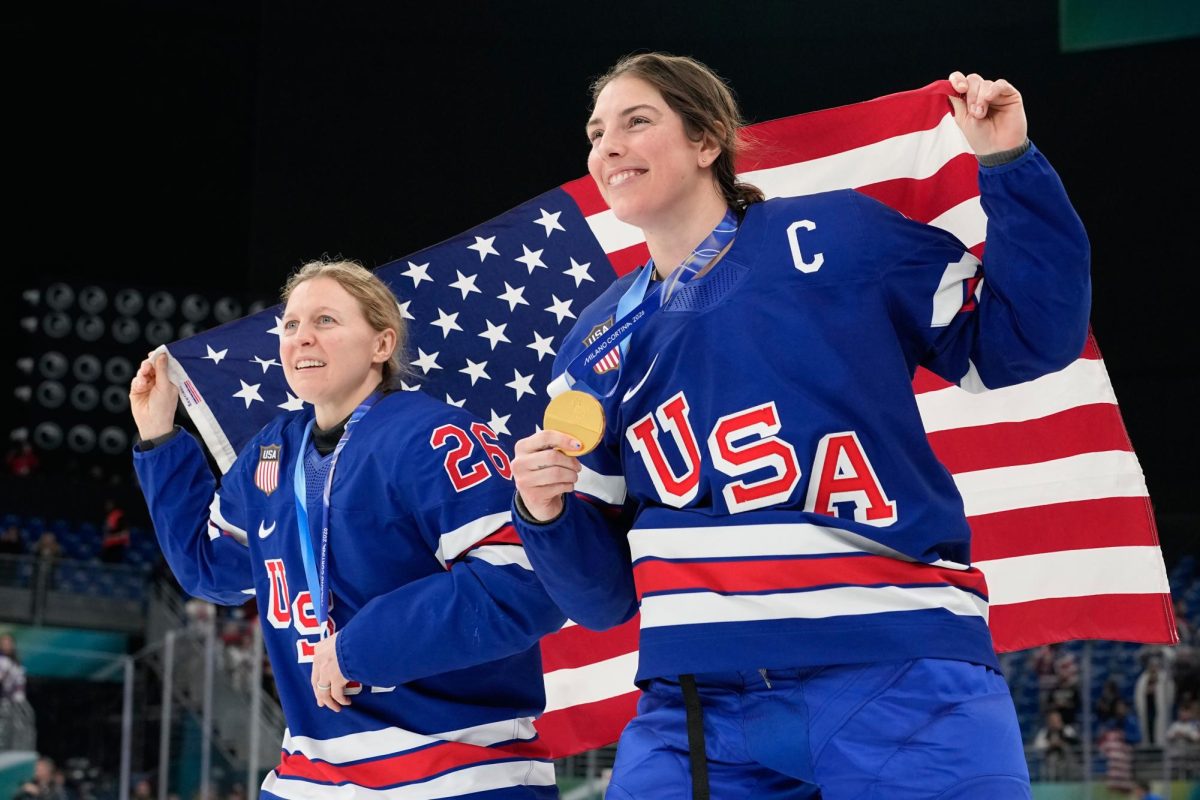
When both Olympic U.S. hockey teams won gold, it should have been uncomplicated: two teams, two victories, one nation celebrating excellence. Instead, what lingered was a joke.
When U.S. President Donald Trump quipped that he would be impeached if he did not invite the women’s team, it was framed as harmless humor. But humor reveals hierarchy. Beneath the laughter was an assumption: celebrating men is expected, celebrating women is political.
That reflex is not isolated. It is part of a broader cultural pattern feminism has been naming for decades.
Feminism, at its core, is about dismantling asymmetry, the idea that men are the default and women are the variation. It asks why women’s achievements are treated as symbolic, while men’s are treated as natural. Why women must manage tone, clothing, and likability alongside competence.
I learned this long before I read feminist theory.
I went to an all girls high school. In that space, I was surrounded by women who made one another stronger. If one of us stumbled in debate practice, another stepped in and carried the argument forward. If one doubted herself, another reminded her she belonged. Leadership did not look unusual. Authority did not feel borrowed. Strength was not something we had to justify.
Before competitions, our coach would remind us, hair neat, skirts appropriate, voices firm but not too firm. At the time, I was frustrated. Judges were supposed to evaluate logic, not appearance. But she knew what we would face. She knew that girls are often judged for intensity in ways boys are not.
Inside our school walls, we practiced power without apology. Now, sitting in college classrooms discussing early remarks of sexism in philosophy, I feel grateful. Grateful that before stepping into coeducational spaces where hierarchy still hums quietly beneath discussion, I knew what it felt like to belong completely. I wish every woman experienced that kind of safety at least once, a room where ambition is not softened, where strength is mirrored back to you.
That experience shapes how I see moments like the hockey joke.
It also shapes how I see the Hughes family dynamic. The Hughes family is one of the most well-known families in modern hockey with brothers Quinn, Jack, and Luke Hughes all playing in the National Hockey League and their mother, Ellen Weinberg-Hughes, a former women’s hockey player and longtime coach in the sport. When a mother who coaches women’s hockey defends her sons’ behavior, it is easy to call it hypocrisy. But feminism teaches us something more complicated. Gender inequality persists partly because women are emotionally intertwined with the men who benefit from it. There is love, pride, and loyalty. There is the instinct to protect your child before you critique the system. Sexism rarely has a distant villain. It lives in proximity.
And yet proximity does not erase structure.
Feminist Michelle Rosaldo described what she called global asymmetry, the disproportionate assignment of value and authority to men. Even when outcomes are equal, meanings are not. Both hockey teams can win gold, yet only one victory feels inevitable.
Look at Olympic history: Serena Williams redefined dominance in tennis, yet her body and temperament were scrutinized more than her skill. Simone Biles revolutionized gymnastics, performing skills no other woman could match, yet faced criticism when prioritizing her mental health. Megan Rapinoe led the U.S. women’s soccer team to victory and demanded equal pay, becoming both a champion and a lightning rod.
Trailblazers are rarely allowed to simply exist as athletes. They become symbols, controversies, debates.
The wage gap persists. Women in the United States still earn, on average, less than men for comparable work, with disparities widening for women of color. The Women’s National Basketball Association continues to generate talent that rivals the NBA in skill and dedication, yet players are paid a fraction of what male athletes earn. These disparities are defended with market logic, but markets themselves are shaped by cultural valuation. When women’s sports are treated as secondary, investment follows that assumption.
Sexism is not just about attitudes. It is about valuation.
And valuation is global.
When we talk about Iran, nuance matters. The Women, Life, Freedom movement emerged after the death of Mahsa Amini, a young woman detained for allegedly violating dress codes. Schoolgirls removed their headscarves in protest. Some were killed. That is not liberation.
But feminism in the United States must also resist oversimplifying Iran as a backdrop for Western moral superiority. American leftist feminism sometimes assumes liberation looks one specific way, unveiled, secular, Western. Yet feminism, at its heart, is about agency. A woman choosing to cover herself can be as much an expression of autonomy as a woman choosing not to. Liberation is not defined by fabric. It is defined by choice.
Liberation is not bombing an all girls school. Liberation is not violence in the name of saving women. Liberation is the absence of coercion, whether that coercion comes from the state, from culture, or from expectation.
The spectrum of sexism stretches from subtle calibration in debate rooms to lethal enforcement in authoritarian regimes. They are not equivalent in severity, but they share a root assumption, that women’s bodies and behaviors are subject to regulation.
When a political joke frames celebrating women athletes as optional, it echoes that same hierarchy. It suggests that women’s excellence is negotiable.
I think back to my high school often. I think about the sound of girls arguing fiercely about policy, unafraid of being called emotional. I think about how we clapped for one another without hesitation. I think about how, if one woman could not do it, another woman could.
That is feminism at its most powerful, not just critique, but creation. The creation of spaces where women do not have to shrink.
Both hockey teams won gold. That fact should stand alone.
Feminism asks for nothing more radical than this, that women’s victories be treated as victories, not as political statements. That women’s autonomy be respected whether expressed through speech, sport, or self presentation. That every girl grows up knowing what it feels like to belong in her own strength.
That is not a demand for special treatment.
It is a demand for symmetry.