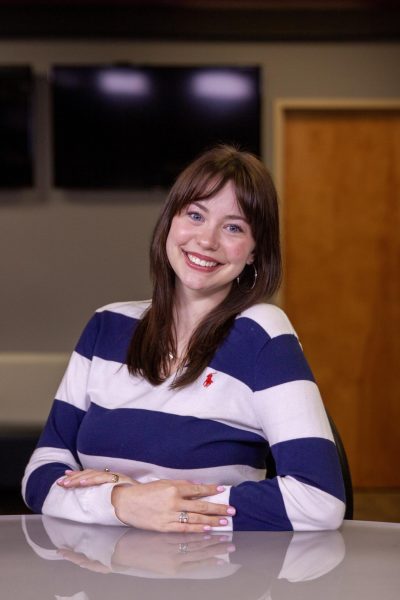
Bernadette Lambert, a 26-year-old Louisiana native and elementary school teacher said the amount of medical stories she was seeing on TikTok was scary, and led her to delete the app.
About one in six adults report using social media to seek out medical advice according to a poll from KFF, a nonpartisan organization that studies U.S. health care issues.
The results of this poll say that 40% of TikTok users report trusting the medical information they are seeing on the app. There are currently around 136 million U.S. TikTok users according to Demand Sage, a platform with data reporting and research. Health content on the app has been increasing gradually since 2021 when it grew by 600% according to MDPI, an academic journal.
Samuel Carter, who is speaking on his own behalf and whose views do not represent Ochsner, is a doctor of osteopathic medicine and neurocritical care staff physician at Ochsner Medical Center. He has practiced medicine independently since 2022 and noticed an increase in people using TikTok, a popular app with short form vertical videos, as a source of information since the COVID-19 pandemic.
“I think it has become a lot more common for this to become something that’s directly brought up or discussed with patient care,” Carter said.
He believes the increase comes from anyone being able to claim expertise and access to a larger audience that comes with TikTok.
“This has led to people who maybe were restricted in audience, now being able to reach a much wider audience,” Carter said.
He also explained that people feel more comfortable when they get confident solutions, and sometimes doctors cannot give a 100% reliable solution.
“People will often reach for someone who is confidently providing some solution or cure to something that the main medical establishment may not feel so confident about, and people especially in a desperate reach for such things,” Carter said.
The doctor shared that he has seen this issue prevalent in people who are in need of more high risk treatments, such as chemotherapy.
“People want to keep their options open and if there’s somebody out there who says, ‘well, you don’t have to do all those scary things that you’ve heard you can do this instead’ And you’ll always find someone online who can give testimony that it worked for them,” Carter said.
In terms of his day-to-day work, he said that he tries hard to ensure that his patients and their families understand the treatments being offered and that they feel completely comfortable with the treatment plan.
“It’s our job as physicians to try to inform and educate our patients, but we also need to hear them,” Carter said.
He continued saying that people are seeking out information from platforms like Tiktok because they are desperate and scared.
“They may have been told that this disease is not curable. They don’t want to hear that. And I can totally understand that. Most people are seeking these alternative options out in good faith,” Carter said.
He went on to explain one of the main risks is that people will delay necessary treatments to pursue alternative therapies first and their conditions will worsen, sometimes to the point of permanent harm.
“I think cancer is the number one example, but many autoimmune diseases progressing can cause permanent harm, if not addressed timely,” Carter said.
He said it has also led to a larger general mistrust of modern medical care.
“Some of that mistrust is based on legitimate problems, the medical establishment has, many times, been unfair or racist or not responsive to minority populations and their needs,” Carter said. “So these sorts of things have really allowed the alternative and non-evidence-based practices to make their way in.”
Alexis Ford, a 26-year-old graduate student said that she doesn’t always trust doctors and often goes to the internet as a first option.
“If getting in to see the doctor was easy, I would call the doctor, “ Ford said.
She guessed that about 10-15% of the videos she sees on TikTok are medical related. Clark Lambert, a 28-year-old music teacher, agreed with that statistic and said that he used the internet as a way to find solutions to symptoms rather than searching for diagnosis.
“It’s normally for symptom relief, if my throat hurts I will look up what to do,” Lambert said.
He added that he rarely visits the doctor because it’s such a “hassle.”
“I rarely go to the doctor, the only time I went to the doctor in the last five years was when I was coughing up blood,” Lambert said.
Bernadette Lambert said that medical videos on TikTok have been more harmful than helpful for her.
“Somebody would post a story about some sort of disease that they have and then I would google how to prevent that in myself,” Bernadette Lambert said. “I think it was very harmful for me and that’s why I deleted the app.”
Carter said that social media is here to stay, and medical professionals need to learn how to use it to reach people. He added that there are plenty of reliable medical accounts on social media platforms.
“Certainly there are a lot of really great accounts that are run by people who are able to explain and show the benefits of evidence-based medical, modern medicine in a way that does reach patients,” Carter said.
He ended with a reminder that the main priority, no matter the platform, should be physicians building trust with their patients.
“We have to always remember that it’s not the patient or family’s job to have gone through all those years of medical training and be able to interpret advanced papers. We have to be able to take complex concepts and explain them in a way that you shouldn’t need a degree to understand. And it is 100% possible. There’s no excuse not to do so,” Carter said.