The U.S. Supreme Court is hearing the Louisiana v. Callais case for an alleged violation of the 1965 Voting Rights Act regarding the constitutionality of considering race in redistricting.
This case reaffirms the constitutional right of all citizens to vote. It also established processes by which federal authorities could review how states and localities enacted policies or legislative maps that may disenfranchise voters. It emphasized the Voting Rights Act of 1965 in protecting the rights of marginalized communities within America.
While the Voting Rights Act of 1965 was fundamental in fighting against discriminatory voting practices, Section 2 of the act is being challenged for the second time with this case.
“Section 2 of the Voting Rights Act of 1965 prohibits voting practices or procedures that discriminate on the basis of race, color, or membership in one of the language minority groups identified in Section 4(f)(2) of the Act,” is how the Civil Rights Division from the U.S. Department of Justice defines section 2 of the act.
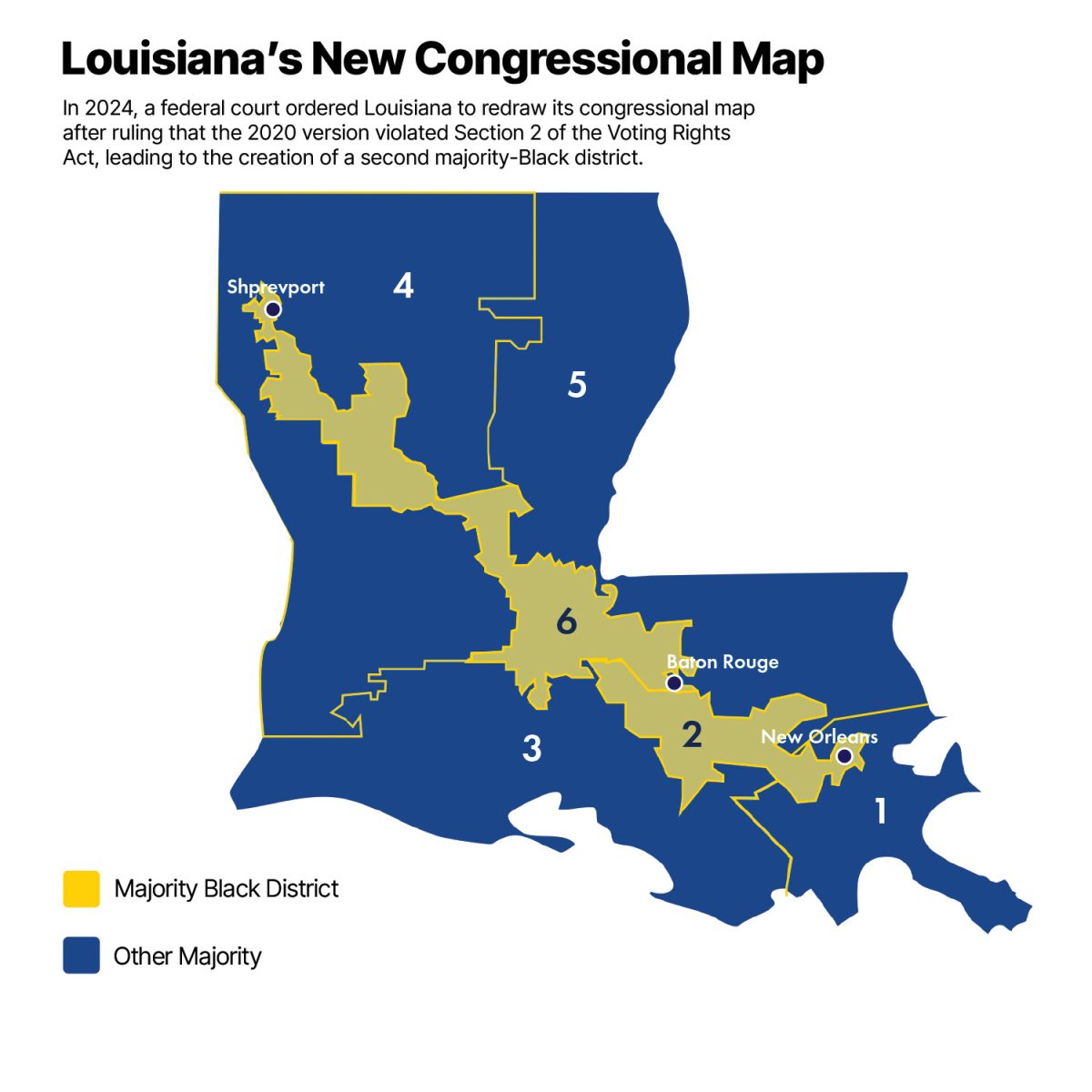
Prior to the current alleged violation of Section 2, in 2022 there was another alleged violation of Section 2 regarding the misrepresentation of black voters within Louisiana’s congressional districts. Due to one third of Louisiana’s population being black, black voters and protestors argued the congressional districts should accurately represent the black population. Since Louisiana is carved into six congressional districts, the map was redrawn with two of the districts being majority black as a way to account for Louisiana’s black population.
Despite this effort to solve the dispute over racial dilution amongst black voters by redrawing the map, a group of white voters argued taking race into consideration when redistricting is unconstitutional regardless of intention. Redistricting brings about the potential issue of gerrymandering, specifically in this case where congressional districts were drawn to represent a certain group of people.
A nationwide concern is the constitutionality of this ruling and how it will continue to shape future rulings debating whether or not race should be considered even without the intent of discrimination.
Sean Cain, a political science professor at Loyola, expressed his concerns with the ruling.
“If the supreme court may have a major ruling on the voting rights act or a minor ruling on the voting rights act, but either way their basis for doing so, in my opinion, will likely undermine, continue to undermine, the very wording of the constitution which says congress shall make the appropriate legislation to protect the voting rights for for racial minorities or just to prevent discrimination in voting based on race or previous condition of servitude,” said Cain.
A part of this concern is the issue of recent gerrymandering, the manipulation of congressional districts to put a certain party or group of people at an advantage or disadvantage. The party in this case, black voters, will be put at a disadvantage if districts are redrawn.
Nicholas Oliver, a political science major at Loyola, expresses his personal concern about the possibility of political leaders gerrymandering districts and undermining the Voting Rights Act.
“Section 2 being removed is bad because it’s going to remove the minority voting power in the United States, like all of it, because when this is passed its going to start a free for all for Republicans to just start eating up little areas, cutting up all areas and just making this kind of Republican heavy congressional map,” Oliver said.
The Associated Press contributed to this report