
Earlier this month, Loyola film school alum Jonathan Presson sent me a message about his film being selected for the New Orleans Film Festival. He explained that his film “Last of the Shrimpers” and alum Oliver Parker’s film “In the Light of a Miracle” were the only films accepted into the festival in Loyola student history.
We posted a short brief encouraging students to attend the festival in last week’s issue, but Parker and Presson couldn’t get rid of me that easily. I’ve done a deep dive into their experiences with their films before, during, and after the festival. If you couldn’t get a ticket, here’s what you missed.
The week before the festival
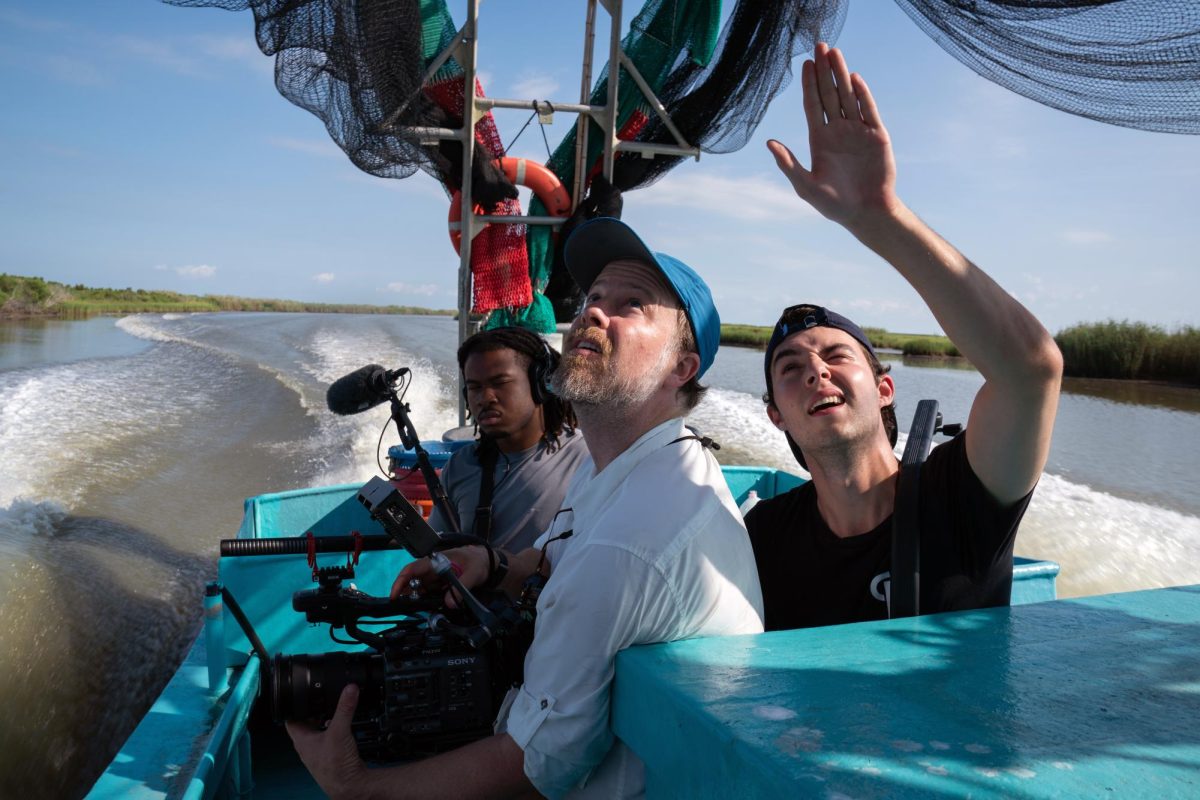
Presson made a short documentary about the shrimping industry in Louisiana. As a Minnesotan who knew nothing about shrimping a few years ago, Presson explained that his process of looking for local videography work led him to the New Orleans Jazz Museum.
From there, Presson was connected to the Louisiana shrimp museum, which is a shrimp processing plant that is currently fundraising to add a museum space. The museum commissioned Presson to make the film, which also served as his senior capstone project.
When he saw that the museum was trying to maintain a piece of fading history, Presson began to brainstorm with the museum’s owners as to how he could use video media to capture the struggles of the industry.
“I pitched this idea of a short documentary that they could play inside of the museum,” Presson explained.
This would serve two purposes—to market the museum and to educate viewers. The museum agreed to the project in December 2023, and Presson worked on the documentary for another year and half.
“I think we kinda manifested getting into the New Orleans Film Festival from the get-go—I pitched that to the museum before they even approved the project,” Presson said.
Presson’s work was selected to be shown in the category “Louisiana shorts: Portraits.” Presson explained why his work was synonymous with the values of the festival—he’s a first-time filmmaker highlighting a Louisiana story. “I think the local community values those stories so much,” Presson noted.
Presson’s passion for documentary filmmaking began during his junior year of high school. He watched a documentary called “Last Chance U”, a documentary series about a JuCo college football team.
“It’s all these players that are talented enough to be at the D1 level, but for whatever reason, they’re shipped off to these schools. It’s their last chance, essentially, to make it big and prove themselves and make it into D1 schools or the NFL,” he said.
“Last Chance U” inspired Presson to make a documentary about his high school soccer team. I noticed this “last chance” theme is also prevalent in Presson’s film, as a documentary urging the audience to notice and help save a dying industry.
By the time he began at Loyola, however, documentary filmmaking wasn’t high on his priority list.
“Coming into the program, I was pretty dead set on being a cinematographer,” he explained, noting that making “Last of the Shrimpers” led to him falling in love with making work that resonates with and impacts people.
Presson said he was nervous to go to the New Orleans Film Festival as a student. He felt that because he wasn’t a big name in the industry, he wasn’t sure if he would be welcome. Now, he urges students to attend the festival, saying the filmmakers are down to earth, and discounted or free tickets are easy to come by.
“I went to the film festival for the first time last year, and I was able to watch a bunch of short documentaries,” he said.
This was around the time Presson was editing his film, and he explained that this was a great time for him to find inspiration and build connections. Presson was able to send clips of his work to other festival attendees for feedback.
“To be able to get your film in as a student is a big deal,” Presson said, noting that students selected for the fest are going up against industry professionals. The event isn’t just a one-off event to showcase local work. Presson added that winning an award at the festival makes the filmmaker eligible for Oscar nomination.
Loyola is a small school, and the film program is even smaller. Presson spoke about working with Oliver Parker on various projects during their time in the Loyola film program. They both speak so highly of each other, I see the two of them as pageant competitors holding hands onstage before the winner’s name is announced. Although in this situation, they both win.
A few days later, I met Parker via Zoom. “It’s so awesome because I love Jonathan,” he said.
Parker noted how both filmmakers received similar accolades for their works in their time at Loyola, and he worked on projects together.
Parker’s film In the Light of a Miracle was also made for his senior capstone project, and he started writing the screenplay in the spring of his junior year. It was selected by the festival for the “Late Night Queer Shorts” block.
Parker explained the three main inspirations for the film, the first being a gay road trip movie.
“I wanted to make something about serial killers, like the Bonnie and Clyde type of thing, but like, sorta gay and genderfucked.”
Parker credited other road trip films such as “Badlands” and “My Own Private Idaho”.
“A lot of times they tell you not to do a road movie because it’s difficult and it’s dangerous and sometimes illegal, but I was like ‘I’m gonna do it anyway,’” Parker explained with a laugh.
Parker also cited the works of novelist Dennis Cooper as inspiration, saying his books were thematically similar to the film. Parker’s third and final point of inspiration was religious iconography, specifically through images of Catholic sainthood.
Parker recruited his friend Turner for the film, explaining that Turner had the air of a movie star, looked just like Martin Sheen in “Badlands”, and drove a 1985 blue Chevy. It’s clear from our conversation that Parker is inspired by visual themes, but he also mentioned how his personal history contributed to the story he wanted to tell.
Parker is from Baton Rouge, an area heavily inundated by Exxon plants.
“I wanted the landscape of south Louisiana to be very central, because it does have its own oppressive mechanism. The economy is so contingent upon the oil plants, and it’s so environmentally disastrous.”
Parker noted that driving from Baton Rouge to New Orleans inspired him to incorporate the imagery of Cancer Alley into the film.
“The main character is this guy named Andre, who’s 17, and he’s kind of maybe a girl, and he gets picked up by this older gay guy, and they’re trying to evacuate from a hurricane,” Parker explained, before detailing that he wanted to illustrate all the power structures (the landscape, the economy, the hurricane) pressing down on Andre.
Parker had been feeling some pressure himself, working in an industry that can be inaccessible for young directors.
“I feel like people think that the movies are dead,” Parker noted. “I’m sometimes scared that the movies are dead.”
When I asked him what he wants audiences to gain from his film, he explained, “I hope people seeing my movie think, ‘Here is a young person with a voice and a perspective and a style.’”
After mentioning that goal, Parker noted, “I don’t think movies are dead yet. I think there’s still time.”
Parker explained that he’s worked at the festival for three years, first as an intern. After a few seasons, Parker worked in ticketing credentials and contributed to the website. He noted it felt really weird to not work at the festival this year, but he felt excited to be on the other side.
“It’s an awesome festival because they are so hyper-focused on amplifying voices from the South, which is not something that anywhere else in the country has done.” Parker laughed, before explaining that it was his main goal while making the film to make it into the fest.
The weekend of the festival
On Saturday night, I arrived at the Contemporary Arts Center and got a seat in the packed warehouse theatre to watch Presson’s film.
Presson’s film was first up, which was followed by an hour and 15 minutes of documentaries, and then a short Q&A with the filmmakers. Other shorts focused on local artists, a tour guide, and a kid who loved to dance.
I felt that Presson’s film was unique, as it focused on one blue-collar man. Oftentimes in artistic spaces like film festivals, rural and industrial narratives can easily be underrepresented. However, “Last of the Shrimpers” highlighted a very real local economic issue.
My favorite shot of the short was the view on the deck of the shrimping boat, set to a hopeful instrumental by Pablo Amat. It comes after some pretty crushing scenes about the industry suffering, so seeing birds against a bright blue sky set a more hopeful tone.
Presson stood next to his main character during the Q&A, an older shrimper named Acy Cooper. It’s an emotional topic, and Cooper tears up at one point in the film. During the Q&A, Cooper emphasized to the audience the importance of eating locally caught seafood. You can tell that the two have bonded through time on the boat and interviews.
Something I noticed about Presson during our initial interview was his use of the term “we” through his play-by-play of how the film came to be. It’s clear Presson’s community has been a large part of this project, and it showed in his crowd of groupies on the film’s debut at film fest.
Presson’s girlfriend Emily Schaefer attended the festival by Presson’s side. “She was the consulting producer on the project after many late nights of watching the film with me and giving feedback,” he explained.
Parker’s showing was the next night, at 8:30 p.m. on a Sunday. Definitely a sleepy time, but the crowd in line for the small black box theatre was anything but that. I approached Parker and was instantly hugged by his mother—it was clear there was an air of celebration for the whole evening.
During the screening, audience members chimed in and quipped about the films, shouting out jokes that elicited laughter from the rest of the audience. Sad “awws,” snaps, and “I know that’s right!”s continued through every film.
Parker mentioned Presson during the Q&A section, noting that Presson loaned him his drone so he could shoot more complex shots. Presson was in the audience for Parker’s showing, and if it wasn’t an extremely small theatre where everyone could see everyone, I’m sure I would’ve turned around to see Presson smiling.
Parker the week after the festival
Parker answered my questions on our final Zoom with the same easygoing laughter as last week. He noted that he was more nervous at this showing than previous ones. “In the Light of a Miracle” was shown to audiences at Parker’s senior showcase, a Zotz movie night, a private showcase, and the Scumdance Film Festival.
“The day before, I was so nervous, I sat in my house all day and just watched ‘The Real Housewives of New York’ ,” Parker explained. One margarita later, Parker was ready for the festival.
Parker mentioned that a reason for his nerves could’ve been the Q&A following the showing.
“It was my first time being Q&A’ed by somebody I don’t know, and so I guess it was like ahh, this is frightening,” he added.
I noted that Parker’s film was shown last in the group for the evening, which likely wasn’t a coincidence.
“A lot of the shorts that played before mine were like ha-ha funny, while mine is not necessarily,” Parker said with a laugh.
Parker explained that the film got more laughs at previous events, where the audience had a higher concentration of people who had worked on the film. He acknowledged the film has a very surreal sense of humor, which, he explained, not everybody thinks is funny.
A message from Scumdance Film Festival director George Sukara detailed another time that the film quieted the audience. “The director of the festival emailed me, and was like, ‘Your movie really bummed out a whole lot of people, like it really sucked the air out of the room. I love it!’” Parker recounted with a laugh.
Bumming out a room clearly has perks—Parker received the Lola Jett Award for Best Cinematography at that festival.
Parker found it interesting to see how different audiences receive the film, and he feels a sense of release knowing that it’s being shown to more and more audiences.
“This has nothing to do with me. I kinda have to give it to other people now,” Parker noted. “I’m going to New York this weekend for another festival, so I’m excited to see how it’s received.”
There was one low point for Parker, as the film was played at a quieter volume than the director would’ve preferred.
I personally couldn’t tell the sound was off, as my focus was mostly on the visuals of the film. There’s a strong use of red throughout the film, and the Catholic iconography and local landscape are consistent throughout.
The final shot, a classic religious image, was the most memorable part for me. Sonically, the film consisted of icy dialogue between the two main characters as well as a voiceover. The credits then rolled to “Ian Curtis Wishlist,” an alternative synth song by Xiu Xiu.
Of the other shorts shown in Parker’s group, his favorite was “Capitanes”, a surreal film about a homoerotic soccer team, directed by Kevin Castellano and Edu Hirschfeld.
Parker mentioned that he was complimented on making his project work without a lot of funding. “You can definitely tell mine has a small budget—not in a bad way,” he noted.
Parker was also honored to receive a compliment from an audience member who said he could see Dennis Cooper’s influence on Parker. Parker had a list of influences at the end of the credits, an idea he got from watching his professor Nathan Tape’s short film.
Presson the week after the festival
I can give you proof that Presson made the most of his time at the festival; he was feeling too unwell to call and talk about it.
His text message stated, “During the fest I was going to everything that I could from when the day started at 12 PM to when the parties were finishing at 2 AM. After the fest, I’m recovering after doing so much. (Maybe a little too much lol).”
Of the other documentaries shown in Presson’s group, his favorite was “Anywhere I Lie in My Head”, directed by Fernando Macfarlane. The short observed people living in abandoned power plants before they were eventually kicked out.
Presson detailed the differences in this year’s fest as compared to last year.
“The biggest difference was doing way more and having more access to panels, screenings, and VIP events that I didn’t go to the year before. I was able to interact and meet many more people and watch many more films,” he said.
Rest assured that Parker and Presson attended many afterparties together, and you can view both of their films online through the festival’s virtual cinema from now until Nov. 2.