Themes of New Orleans magic, motherhood, loss, politics, and cooking find their way into a new book titled” Lucky Charms,” by The Office Manager for the School of Communications and Design at Loyola.
Sunnylyn Thibodeaux’s “Lucky Charms” is on the Publishers weekly 2026 spring and summer titles with “ something special about them”. Thibodeaux says this is the first time that one of her books has gotten this level of recognition, and it has left her in disbelief.
“I kind of shy away from compliments, if you will. I’m like oh, that’s really exciting. And now I’m gonna go over here and hide,” Thibodeaux said.
The Creation of “Lucky Charms’
Thibodeaux’s upcoming book of poetry is a collection of poems that spans 25 years of her life, with a special focus on home and what it means to her.
“What’s interesting is so much of this book was written while I lived in California but so much of the themes are New Orleans, because this is home,” she said.
Garret Caples, an editor at City Lights, worked on “Lucky charms” with Thibodeux and said that working together was “somewhat telepathic.”
“I would get a version and have some thoughts and she would address those thoughts without me having to send them to her. It had a bit of poetic magic to it,” Caples said.
“Lucky Charms” is part of a series that City Lights Publishing does called the Spotlight Series. The focus of this series is to shine a light on a poet that has a catalogue of works that isn’t getting tons of recognition.
Caples said that Thibodeaux was a good fit for the Spotlight series because she has a body of work that spans time, and he thought people would appreciate seeing it put together.
“Her work ought to be presented, and City Lights has kind of a bigger reach than the small press,” he said.
Caples praised the humanity in Thibodeaux’s work, saying that it comes through clearly in her writing.
“You can really just feel the human being in Sunnylyn’s work,” Caples said. “This is a book about real human experience.”
Thibodeaux spoke about the title of the book, sharing that it came from the title of the opening poem in the book. She said Caples encouraged the title saying that it tied into the themes of her writing.
“[Caples] felt like my work could all kind of link back into the idea of something talismanic. Like a charm,” she said.
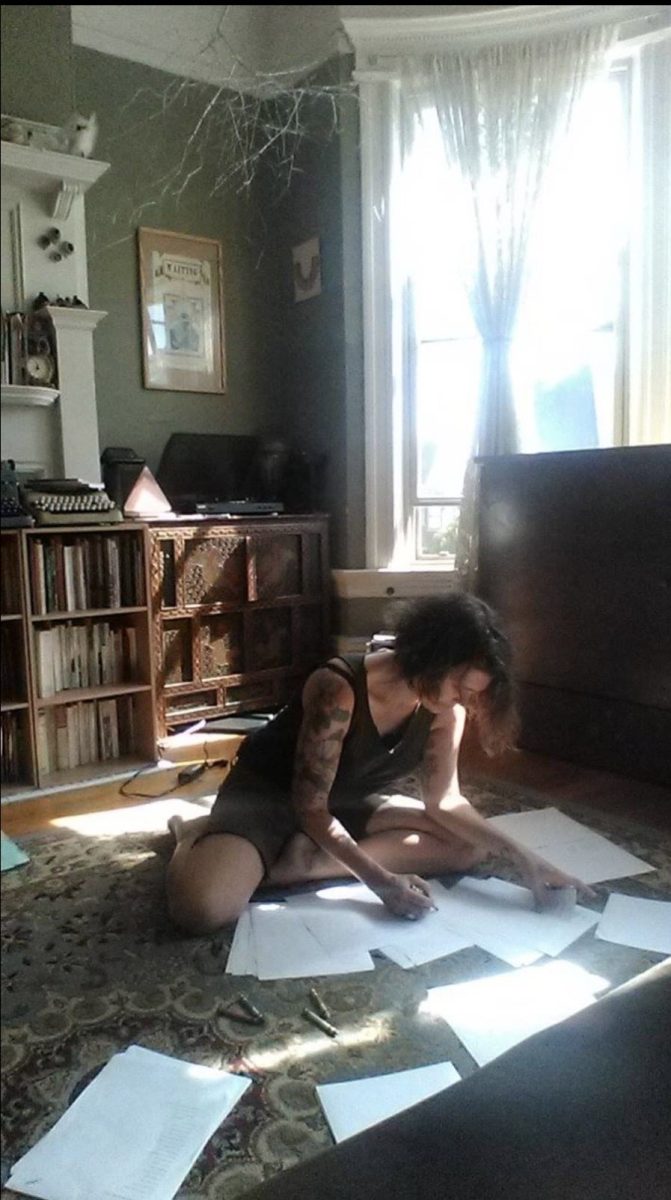
Thibodeaux referred to the process of putting the book together as “the stringing of pearls”. She said this starts with finding the ways all the poems link, and to do this she lays the pages of her manuscript on the floor.
“I am on my hands and knees, and I am looking at it, and I am seeing things that you don’t necessarily get flipping page to page,” Thibodeaux said.
Thibodeaux’s history as a writer
Thibodeaux recalls that she first began writing when her mother gifted her a notebook.
“I was the type of kid that was a little nervous, kind of like hiding behind my mama’s leg, you know? And there was a point, I think, probably around the age of 11 or 12 that she was like, I don’t understand you. Write it down,” she said.
Thibodeaux describes her receiving the notebook as the “most intimidating and friendliest thing” she’d ever received.
“These blank pages were an open invite to share without judgment. And so that’s how it started,” Thibodeaux said.
She shares that her first introductions to poetry included Edgar Allen Poe and Auden. She remembers feeling fascinated by them and the way they helped her to articulate what she was feeling.
“What came next was a freedom to articulate things, the good, the bad, the ugly, and the glorious,” Thibodeaux said.
She reflected on the first time she got published, sharing how wonderful it felt to hold her first book complete with a spine and ISBN number. Thibodeaux is a self proclaimed “ book maker” and lover of little things that can be handed out to loved ones.
“That was just a whole other level of excitement and pride, to feel the tangible product that you have poured yourself into writing in your hand,” Thibodeaux said.
Moving back to New Orleans Thibodeaux shared that the transition from walking everywhere to driving has been hard on her writing.
“I did not have a car in San Francisco. I walked everywhere. I could stop at any point, there was always a notebook in my back pocket,” she said.“I miss the downtime of walking. There’s a slower process, walking places and letting your brain not only absorb what is happening now but process what you need to process.”
New Orleans reflected in Thibodeaux’s writing
Thibodeux shared the ways that growing up in New Orleans shows in her poetry, such as poems about her Sicilian mother, sister, and the rich culture of New Orleans.
“Elements that always show up are a reflection of the cultures that blend here, the richness of our soil, the birds, the trees, the ghosts, and I’m not kidding, we have a lot of ghosts here,” Thibodeaux said.
Thibodeaux says she hopes her work inspires human connection and love of each other.
“Without that, how do we ever progress in humanity? Especially in the times as they are,” she said.
Thibodeaux feels that her goal as poet has been successful when it makes the reader fall in love with something, whether it be a magnolia tree or a blade of grass.
“If I can make you see the world with more love and respect, or see your neighbor with a flat tire differently, then I’m done. Because that’s what it comes down to, love and respect,” Thibodeaux said.
Thibodeaux urges people to slow down, pay attention, and look up.
“I think that’s just it, pay attention, you know, and take notes. Just absorb and pay attention. There are beautiful things in the world, and there are heartbreaking things in that world but that can be beautiful too,” Thibodeaux said.