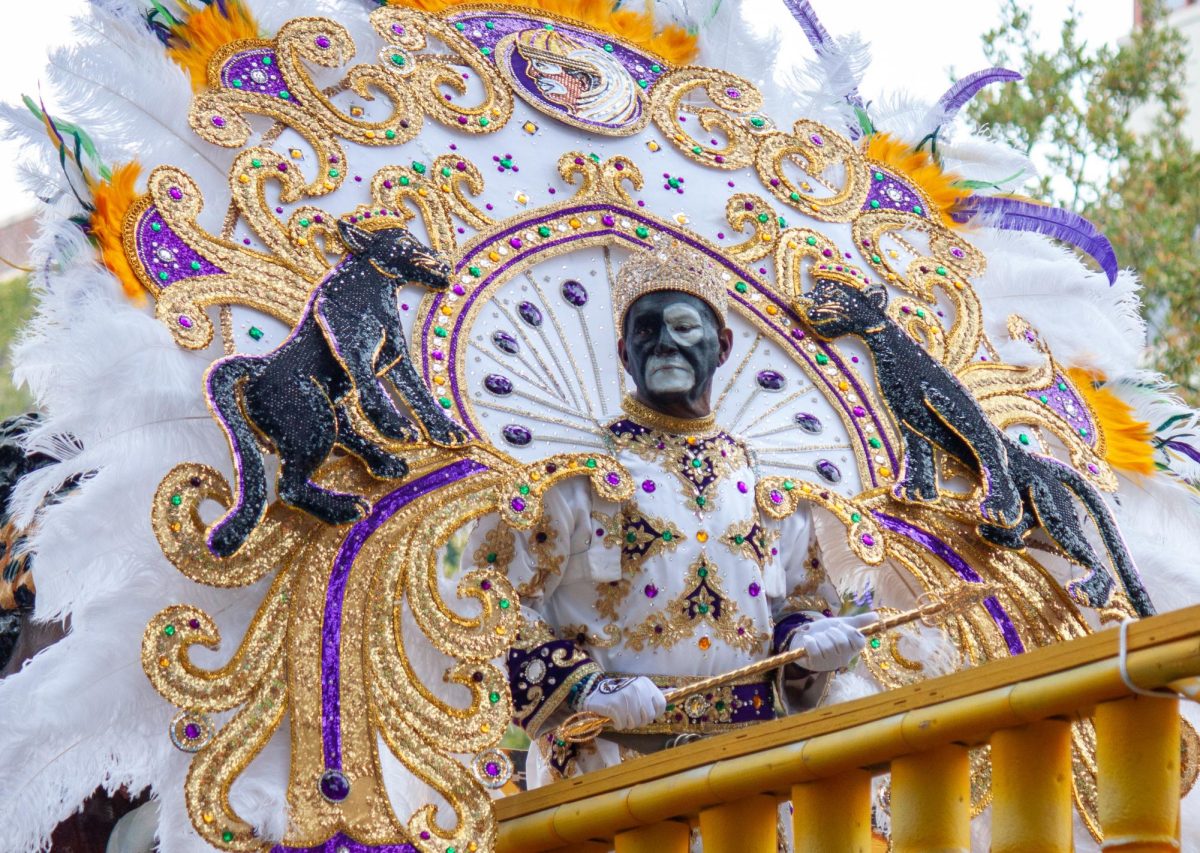
Every year, the Krewe of Zulu leads New Orleans in celebrating Mardi Gras through culture and community while honoring over a century of Black history. The Krewe of Zulu was founded in 1909 as a small walking krewe of working-class Black men, walking through neighborhoods from bar to bar with no elaborate floats. Now, Zulu has cemented itself as one of the most iconic Mardi Gras symbols, carrying that legacy forward every Mardi Gras season.
One of the main positions in the Krewe of Zulu is the Walking Tramps, who lead the parade and are the first walking group. Each Walking Tramp embodies a character through costume and satire, a role you can only earn. Anthony Howard, a Krewe of Zulu full member for the last 16 years, does not take this position lightly.
“You have to be outgoing, you can’t be shy,” Howard said. “It’s the most unbelievable feeling in the world. I start the parade with about 400-500 coconuts. I look for children who don’t expect it or elderly people who can’t get up.”
As most krewes have ‘specialty throws’, Zulu has elaborate hand-painted coconuts, intertwining tradition with a deep connection to the community. This relationship with the parade attendees is not limited to the people on the ground, as the members in the floats get their chance to connect as well. Former float rider Roshunda Conway felt this magic when she rode in Zulu in 2017.
“Instead of following Rex’s route, Zulu turns and goes into black neighborhoods to celebrate with the people who weren’t able to go out and attend Mardi Gras,” Conway said. “Having a lot of throws for these people provides these Black families an equal experience of Mardi Gras like everyone else in the city.”
As Mardi Gras often falls during Black History Month, including this year, Zulu remains a powerful reminder of resilience, pride, and representation.
“Just for one day, a working man can be king,” Howard said. “There is no Mardi Gras without Zulu.”