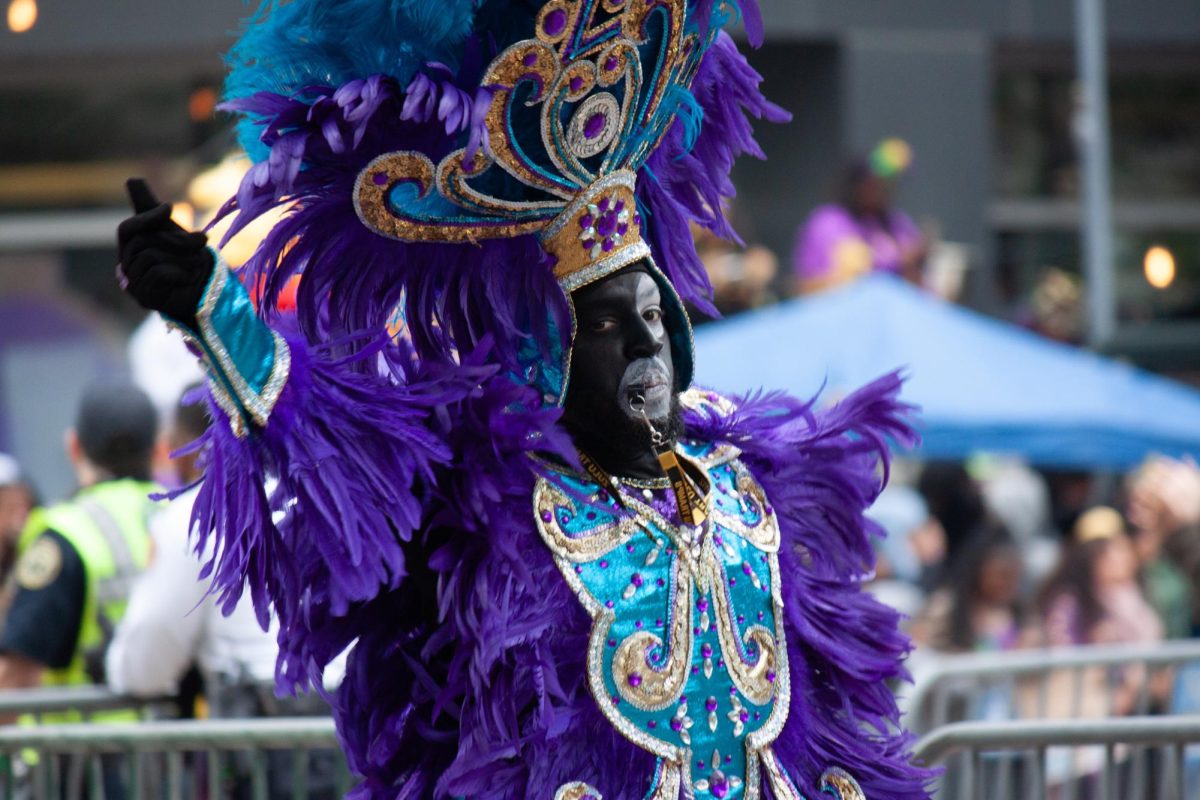
The history of Mardi Gras takes its origins from a Catholic, pre-Lenten celebration predating the colonies. However, throughout the centuries of development, Cierra Chenier writes in Essence, the carnival has shifted into its more recent form through the influence of a predominantly black and Catholic community.
“As a Catholic city with a large Black Catholic population and retained African traditions, the extent of our expression and the fullness of our spirituality are intrinsically linked,” Chenier said.
However, Chenier explained that the implementation of Black culture in Mardi Gras was not simple. Racial exclusion and elitism, she wrote, were dominant amongst carnival celebrations, and black individuals were banned from attending white masquerades. So in response, Black individuals held their own krewes where they performed African masking traditions and eventually also incorporated Black Masking Indians. The Skull and Bones krewe is one of the carnivals that began in this era and continues to drum through the streets of New Orleans’s oldest Black neighborhood.
Wayne Phillips, curator of costumes and textiles at the Louisiana State Museum, provided insight on the alleged history of Black Masking Indians, previously known as Mardi Gras Indians. According to Phillips, the tradition originated back in the 1800s when enslaved people sought refuge within indigenous communities, and later, these individuals wanted to pay tribute to these communities by creating intricately beaded and feathered costumes.
“[The story is] kind of hard to prove, but that’s a generally accepted aspect of the origin of Black masking Indians, which, of course, in itself, is sort of an oxymoron, because you’re incorporating the traditions of two different communities, the 19th-century African American community and the indigenous communities of South Louisiana,” Phillips said.
Phillips also acknowledged another potential origin for Black Masking Indians, which consists of the possible inspiration of Buffalo Bill, a western entertainer. In this explanation, Black men took inspiration from the indigenous outfits and created their own suits that ended up being passed down for generations.
“Neighborhood gangs or tribes were created that adopted a very specific beadwork style that was unique to their neighborhood or their gang, whether it was uptown or downtown, which are still terms that are used today to refer to sort of the variation in costume styles,” he said.
Eventually, Black Masking Indians started to perform music professionally in the 1970s, even participating in the first Jazz Fest.
“That was one thing that really increased their profile in the community and the community’s awareness of them,” Phillips said.
The Louisiana State Museum, according to Phillips, became one of the first museums to collect Black Mask Indian suits as a way to represent Black culture and its influence on Mardi Gras in New Orleans. Phillips stated that the museum may have one of the oldest completed suits in their collection, one worn by performer Bo Dollis before being retired in 1971. Bo Dollis Jr., Dollis’s son, now works at the museum to continue promoting the representation of Black Masking Indians.
Phillips stated that the museum prioritizes the preservation of these suits above all else to ensure that they last to continue educating individuals.
The museum documents other Black Mardi Gras traditions as well, like the Zulu social leader, Pleasure Club, the Baby Dolls, and Black social clubs, that are now displayed in their current exhibit, Origins of New Orleans Black Carnival Society: The Story of the Illinois Clubs, which opened on Jan. 29.
“It’s an exhibition that I’ve wanted to do for many, many years, but about three years ago, I started putting together a group of community leaders and formed an advisory committee that [helped] me arrange this exhibition and schedule it to coincide with the 100th anniversary of the young men Illinois Club,” Phillips said.
The Presbytere is open daily from 9:00 a.m. to 4:00 p.m., and the Origins of New Orleans Black Carnival Society: The Story of the Illinois Clubs exhibit will be open until May 15, 2027.