When New York State Assembly member Zohran Mamdani secured the Democratic nomination earlier this year, it seemed as if New Yorkers had spoken–the young socialist had beaten out Andrew Cuomo.
Former Governor Cuomo refused to accept defeat, however, and changed affiliation to Independent, continuing his campaign for the mayorship. In the ensuing months, Mamdani has led an unstoppable campaign.
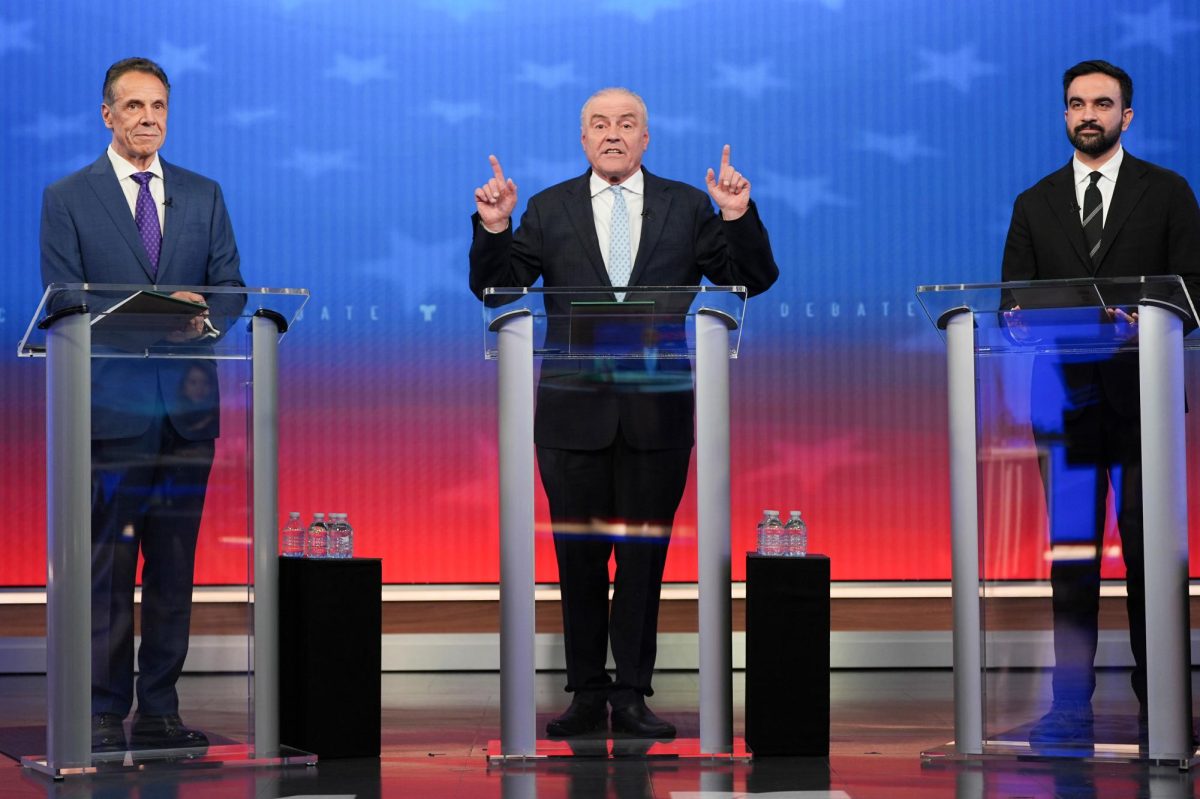
So why is it that Cuomo, a man approaching 70, a failed governor and credibly accused sex offender sits so close behind Mamdani and his audacious run for mayor? What does this say about New York, the Democratic Party, and party politics as a whole? Looking at the recent mayoral debate can perhaps answer some of these questions and point towards the decision that will be made on election night, Nov. 4.
The dynamic of the two candidates in the debate, not counting Republican Curtis Sliwa, put on full display their vastly differing tactics. From the beginning of his campaign, Mamdani has centered himself around his policy. In keeping with this method, he spent much of the night outlining his views and plans for New York.
Cuomo, who has done little in the way of outlining policy, went for the jab-taking route during the debate. Many personal attacks were made towards Mamdani; about his age, inexperience, and supposed naivety. At one fiery point in the debate, when Cuomo commented on his lack of experience, Mamdani rebutted with, “What I don’t have in experience I make up for in integrity, and what you[Cuomo] don’t have in integrity you could never make up for in experience.”
This summarizes one of the biggest differences between the two. Mamdani, though young and lacking experience, is a clean slate, something altogether new for a city more than ever in need of change. Cuomo, on the other hand, is a career politician with a checkered past and a black mark on his governorship. Mamdani must prove himself, whereas Cuomo already has; showing us his ineptitude at leading and his morally bankrupt behavior towards women.
If Mamdani symbolizes a fresh start, Cuomo symbolizes not just his own past shortcomings and poor decisions, not just more of the same, politically speaking, but a fundamental aimlessness which is ever-present in the modern Democratic Party. Since Obama, the Democratic establishment has not put forth anyone, whether statewide or nationally, who is aiming for any kind of meaningful change or shift in party objective.
In a time of such political uncertainty, with intense radicalization and capitulation to said radicalization on the right, no longer can the left flounder somewhere in the center. New York has long been America’s flagship city, and so Cuomo versus Mamdani is not simply a regional question or issue, it has the power of being a major wake-up call for the current Democratic Party, and for the country as a whole. A vast swathe of liberal votership is no longer settling for what the Democrats have to offer. If New York is willing to take a chance on something new, if Mamdani is handed the mayorship and proves himself, there could be a complete shift in the national Democratic Party, whether the establishment likes it or not.
Still, the race remains tight between the two candidates. Whether it’s because of his policies they don’t agree with, his socialist-leaning rhetoric, or simply his age and inexperience, many New Yorkers are unwilling to vote for Mamdani. This, I think, speaks to a broader history of ‘settling for’ that has plagued the American political system as of late, becoming something of an expectation for many voters.
Most Cuomo voters are not voting for him based on who he is, or what he represents on a broader level. Cuomo, like most of the establishment, is a manifestation of Democratian Stockholm Syndrome. Voters have been stuck with these characters for so long that it is what they have come to know and ultimately what they are comfortable with. If New York was bad under Eric Adams, why not keep it bad under Cuomo rather than take a chance on radical change?
And so New York sits, teetering over the edge, on one side change, and on the other, sameness. Election night will show us much more than who New York City’s next leader will be, it may very well set the stage for the future of the Democratic Party. At the very least, it will show that a large number of liberals are fed up enough with the system to allow politicians like Mamdani a platform, and a word in edgewise within the greater political discussion.